Feeds:
Posts
Comments

Pilate’s Sign

The governor took a black Sharpie pen,

some Chinese plywood, a packet of screws.

With left-handed cursive he scribbled a sentence

“Jesus of Nazareth, King of the Jews.”

He put it in Latin, in Greek and Hebrew

In Spanish, in Braille, in the tongue of the Scots

In Semaphore signals, in sign language too

In Morse Code with tiny black dashes and dots

His handyman climbed over Him who was bleeding,

with a cordless drill, screwed the sign on

The crowd all crossed their arms and were screaming

“We don’t understand it . . . we can’t . . . we won’t!”

Give and Take

I gave my back to those who struck me

My cheek to those who plucked out my beard

Yielded my clothes to the drunken guards.

I was exposed to the shame and the spit

My brow, surrendered to a barbed crown

Presented my side to a soldier’s lance

My wrists and feet to iron spikes,

Offered cracked lips to sour wine.

I gave my mother to my bosom friend

My final question to the black of space

and one last breath to my Abba, God

Then submitted my body to a frigid cave.

I took the keys from an ancient foe

Sealed the tomb of torment

Stripped the power of Apollyon

Brought back saints from beyond.

I fashioned crowns and linen robes

Awarded the faithful, granted life

Conferred my name, bestowed gifts

My version of give and take.

If we have a crisis in this country which is national in scope, what to do? The answer to this may depend on our preparation. The crisis hasn’t come yet, so we can still prepare.

First of all, get to know your neighbors. Nothing lowers suspicion of strangers more than becoming acquaintances and possibly friends. In a crisis neighbors will depend on each other if for no other reason than geographical proximity.  They may also be able to share resources such as water, food, and other vital items or supplies. Two heads are better than one — multiply that by a neighborhood and knowledge and skills become more valuable. Less material, but just as important, you will have the moral support. In severe cases, neighbors can share even their homes. Neighbors can keep track of one another and evaluate outside threats. They can also travel in groups for safety and accountability.

I remember in the days following 9-11 that ordinary Americans showed concern for one another. Politeness was everywhere, even on the crowed hectic freeways. We must practice that again in our next national crisis.  Remember that a national crisis is simply personal and family crises multiplied over millions of times. If we react in a selfish way, we are in effect saying, “My life is more valuable than another American’s,” and that is not the model of the great one himself –  Christ – or even of common heroism. Laying down our lives for one another during a catastrophe is the core of life itself. For what is life after disaster if there are no honorable standards to live up to, no sacrificial acts to remember?


The light went out for those among our friends

So sudden, like a wind that slams a door

Not slowly, as when darkness closes in,

or tides that sweep a castle from the shore

The blood drained from our faces, chilled our hearts

Our sobs absorbed within death’s hollow walls

We bent, we broke like trees against the dark.

We spoke their names – and choked – in homes and halls.

Who feels our loaded weight of grief and loss?

They say a child was born to bear our grief

to take our pains, our crimes upon a cross

Our part – a simple prayer and pure belief.

IPAD STORY: TOUCHING

With all the cult-hero worship of Steve Jobs, I thought it was interesting that the Chinese are building his ipads in glorified sweat shops for 60 hours a week making $2 an hour. They live in on-site dorms, or whole families in one room garages built by the factory for their workers. I’m sure the Chinese who look over the balconies of those living quarters are comforted by the suicide nets the company has installed there. Is this the way we want another country to bring us down economically? Ipads…how very touching.

Hungry

My name is Dae-Jung Lee. Food is my religion, my stomach is the temple, and if there is a god, hunger is his spirit. I can practice my religion now, I bow three times a day before the offerings, and sometime, I am ashamed to say, I indulge in something sweet. Like cake or ice cream. I sit on a park bench and after I have ice cream I put my elbow up on the bench casually. But it makes me feel arrogant so I put it once more to my side.

My new world is like my old world, except that now I can eat when I am hungry. That is the only difference. Here there are so many kinds of people but in my other life, there were two kinds of people: guards, and prisoners. If you did everything right, you were a guard; if you did wrong things, you were a prisoner.  I must have done many things wrong, because I was a prisoner.

I had a mother whom I saw from midnight to five in the morning. She beat me and I blamed her for my suffering. I had a brother too, she told me, but I never saw him till the day he was shot for trying to escape. My mother they hanged. They beat me for not knowing about their escape attempt.

I thought the whole world was a prison camp, and that there was nothing else. I didn’t know I lived in a country, or that I had someone called a Great Leader.  One day I learned about my country and my Great Leader. I escaped through electric fence into the real North Korea and I thought it was a heavenly place. People had different clothes and they had food to eat. They had families and they could walk along rivers and under trees, things I had never seen or heard of.

When I escaped North Korea and crossed the river into China, I saw strange things that sparkled. People told me about televisions and cellphones. I saw colorful lights in a massive city, but none of these things interested me. I only wanted to eat.

Today, I live in South Korea, among people whose lives are very complex. They are driven to be successful, they dress beautifully, and they do activities together with their friends, then go home to comfortable beds and soothing music.

But, my world is different. I see the lights, the shining things. I hear the music and the laughter. None of this matters to me. Only one thing matters to me – food. I am consumed by the same religion I’ve known all my life.

A used hat sits on a shelf

Whose head was it on?

Someone who grew weary of that hat

With its felt circle of restriction

and wide brim

and sweat stains.

It blocked the light

and the heat of the sun

and  hid someone’s unkempt hair

I suppose it will keep sitting there

until he comes back for it –

if he does come back

Maybe he traded it in for a better one

A crown of thorns sits on a shelf

Whose head was it on?

Someone who was forced to wear that hat

with its twisted circle of branches

and sharp points

and blood stains

It wasn’t worn for shade

or to block out the sun

It couldn’t hide his unkempt hair

I suppose it will keep sitting there

because he would never come back for it,

when he does come back

I’ll bet he traded it in for a better one.

The Destiny of America

When scribes of some new century lift up the fateful quill

To record in novel tongues what good fortune or grave ill

defined our nation’s tenure as the leader of the world,

of the accolades that followed, or the curses that were hurled

and the meaning of the silence when that final flag unfurled

They will tell of those who longed to call her cherished borders home

like ancient generations venerated Greece or Rome

Or will they sigh of how it rotted like a decadent empire

or perhaps, the noble nation, in one final blaze of fire

chose instead to be a martyr among nations, then expire.

They will speak of how two destinies ran strong and parallel

within the country’s psyche, and how both could bode them well:

The first great vein, a love for God; the other, love for gold

two rivers, one pragmatic, one prophetic which foretold

how conflicted we would be as our narratives unfold

They may write of three small clippers, and the isle of Salvador

Sing the praises of Columbus, or his legacy abhor

Will they see the island natives’ thirst for blood at Navidad?

Or call the Spaniards murderers in the name of some new god,

and the gold prospector mixed with priest as normal, or as odd?

They’ll grant the Mayflower Puritans were those who chose to act

with government ordained by God and sealed by their contract

Or will they vilify the Puritans as ‘puritanical,’

and call the Holy Scriptures they obeyed tyrannical

and citizens who tried to hold to those ideals fanatical?

They’ll report on English settlements that bore the Monarch’s name

like Jamestown, where the gentry soiled their tender hands in shame

How their charter to make money from the New World was embraced

yet the part to bring the gospel to the savages erased

and belief in national destiny laughed at and effaced

Will they honor Jonathan Edwards and the Great Awakening

and mention Wesley’s hymn “O For a Thousand Tongues to Sing”

and tell of how George Whitefield brought salvation to the slave?

Or will they mock the famed revival as sensational and fake,

its role in America’s revolution, censure and berate?

They will pen the great rebellion from the British motherland

as King George damning those Yankees as a renegade young band.

Or they’ll see the first Americans as patriots and strong

and their independent spirit countering despotism’s wrong,

their triumphs and their sacrifices codified in song.

Will they read the Negro spirituals in the style of Amazing Grace

as the triumph of the essence of a noble, battered race?

Recount the trial of Phyllis Wheatley poems to statesmen of her day

how politicians doubted her to Massachusetts’ shame

or will they use the truth of slavery to justify or blame?

Recorders of the future may well cast our Civil War

as a rip across the fabric of the glory that we wore,

or they’ll paint the American psyche with a dark-pigmented stain

and say that state secession was a cover-up for gain

or call the practice of enslaving our own countrymen insane.

They’ll pen volumes of the global wars our men were called to fight,

conclude that freedom was worth defending and this nation did it right.

Or they will call us “ugly Americans” though all we ever asked

was land enough to bury those who died there in the task

to stop the spread of tyranny, and its evil face unmask.

Will they see this current century as a time of great excess

and its people spoiled by government and enslaved by selfishness?

Or will they see the American fiber that rose from New York dust

preserving our republic by sacrifice and guts,

and carved on granite mountainsides “In Christ alone we trust!”

Well every nation has its destiny, but some more nobly called–

This was our birthright, this our place in time and history’s halls.

This was our charge, our hallowed duty between two vast and distant shores.

We judge ourselves, but our descendants judge us even more

as either those who fought and won, or as those who dropped the torch.

We vow this day, here bound by love for this the United States

that our conscience has been laid bare here, our soul scored and displayed

that we will give our heart, our breath, bone marrow, and our lives

To guard our sacred values so that freedom can survive,

and leave the scorn or the praises for posterity to decide.

When the tides of history ebb and flow then sweep the sands away

there remains the fateful hourglass to measure out the day

There to capture in its curv’ed glass some justice’d roguish grains

and weigh them in the balance, then toss them out again

onto a desert stretch of some forgotten beach and countless sands.

Coming Alive

Last month I registered a prayer in my journal. I asked God to let me be truly alive, to feel deeply and express that toward others, to love people and God like I should.

Here’s what happened. My swimming pool had been drained for about two weeks and I had gotten accustomed to it being empty. I cleaned it out, fixed everything up, then decided to fill the pool.

The day the pool got full, I went walking by it to check on my firebowl. As I saw the water in the pool I had the strangest sensation in my emotions, like a welcoming attitude toward the water, as if I had actually missed it. For an instant, the water was alive, it had personality, it evoked feelings in me. I felt that I was seeing an old friend again.

Does that prove that I am truly coming alive and able to fully feel again. I’m not sure. But I know one thing: it was something I had never felt before.

I’m sure a man lost in a desert would have fantastically alive feelings at the sight of water. Or a man coming home from a dangerous war battle would feel he had come back from the dead when he sees his family for the first time again. Perhaps a woman can feel truly alive after her first-born child takes its first breath and is laid on her chest.

Whatever makes me come alive, I want more of it, and I want to never tire of that thing.


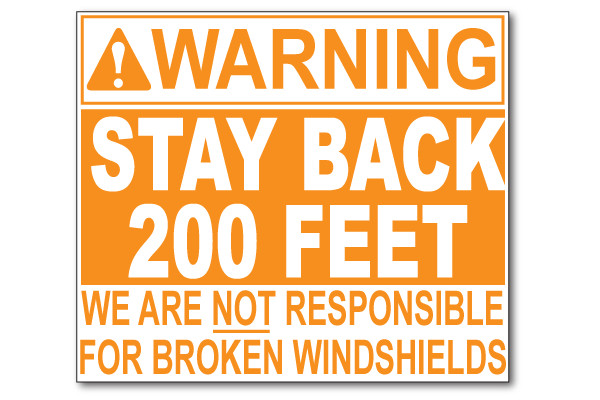
Broken Windshields

I was fifty feet behind the truck before I could read it. Even with 20/20 vision I could not read the sign at 200 feet.

What could break my windshield from a gasoline tanker? A driver, angry that I was within 200 feet, could throw a bottle out his window, I suppose.

My question is – and I think it’s valid –why make a sign that can only be read at one’s peril?

I think that symbolizes what has happened in our culture:

We’re in danger of something hitting the windshield of civility because we’ve broken through the 200-foot moral barrier.

THE EIGHTEEN (WHEELER) COMMANDMENTS

Stay 200 feet away from

the broad metal backside of sin

A mile away from immorality

A league away from lust

Give wild urges a wide berth

Keep a safe distance from damnable doctrines

Avoid vanity and forego ego at all costs

Watch for falling rocks of faithlessness

Don’t be adrift in the wake of wickedness

Finally,

Don’t follow any THING if you cannot

See what is in front of the THING!